
· by Michael Blair, Nashville's Landscapers
Almost every planting-against-the-house problem starts with sizing the gap to the plant that went in rather than the plant it will become. The nursery tag lists a mature width. Half of that, plus a few feet of clear space between the grown plant and the wall, is the minimum distance from the foundation, and for most shrubs that is farther out than people are comfortable planting. It is the first thing we measure when we lay out a foundation bed.
Start from mature width, not pot size
A shrub that reaches six feet wide needs its center three feet from the wall just to avoid touching it, and touching is the wrong target. We add at least three feet of clear space beyond the mature edge, more for a shrub that will also grow tall, which puts that six-foot shrub’s center six feet or more from the foundation. Contact with the house is a termite question too: the University of Kentucky’s fact sheet on protecting a home from termites says vines, ivy and other dense plantings touching the house should be avoided, and that termites are more likely to infest where the soil next to the foundation stays moist.
That clearance is also the room to walk behind the shrubs, and someone always needs it: the termite inspector, the painter, whoever services the hose bib or the crawl space vent. Plantings that block the wall get cut back hard later, and some shrubs do not come back from it. University of Missouri Extension’s guide to pruning ornamental shrubs notes that junipers seldom grow new shoots from bare stubs, so green foliage has to stay on any juniper branch that is cut back.
Trees are a different calculation
With a tree, the concern is less the trunk meeting the house than the limbs and roots it will have once grown. Virginia Cooperative Extension’s “How NOT to Kill a Tree” lists planting close to a house among the ways to shortchange a tree’s growing space for roots and crown, and its advice is to know how tall and wide the tree will get and space it away from the house to match. A small ornamental such as a dogwood or a redbud can sit much closer than a shade tree, an oak, a maple, a tulip poplar, which wants its whole mature canopy clear of the roof.
If a tree outgrows its spot beside the house, topping it to keep it off the shingles is the obvious fix, and the same Virginia list counts topping as a way to kill a tree, because it brings on watersprouts that weaken it. The time to settle the distance is at planting. In a small Nashville lot that sometimes means choosing a smaller tree rather than squeezing a big one in.
Which way should the ground slope after planting?
Whatever goes in, the ground should still fall away from the house afterward. The Kentucky termite sheet says the soil next to the foundation should be graded so surface water drains away from the building, and that sprinklers and irrigation should be aimed so water does not puddle near the foundation. A bed built up against the foundation to hold mulch and plants can undo that slope and turn rain back toward the crawl space or basement wall. The same sheet wants wood siding and door and window frames at least six inches above ground level, so bed soil stays well below them. If the yard already pitches toward the house, that is a grading job before it is a planting job.
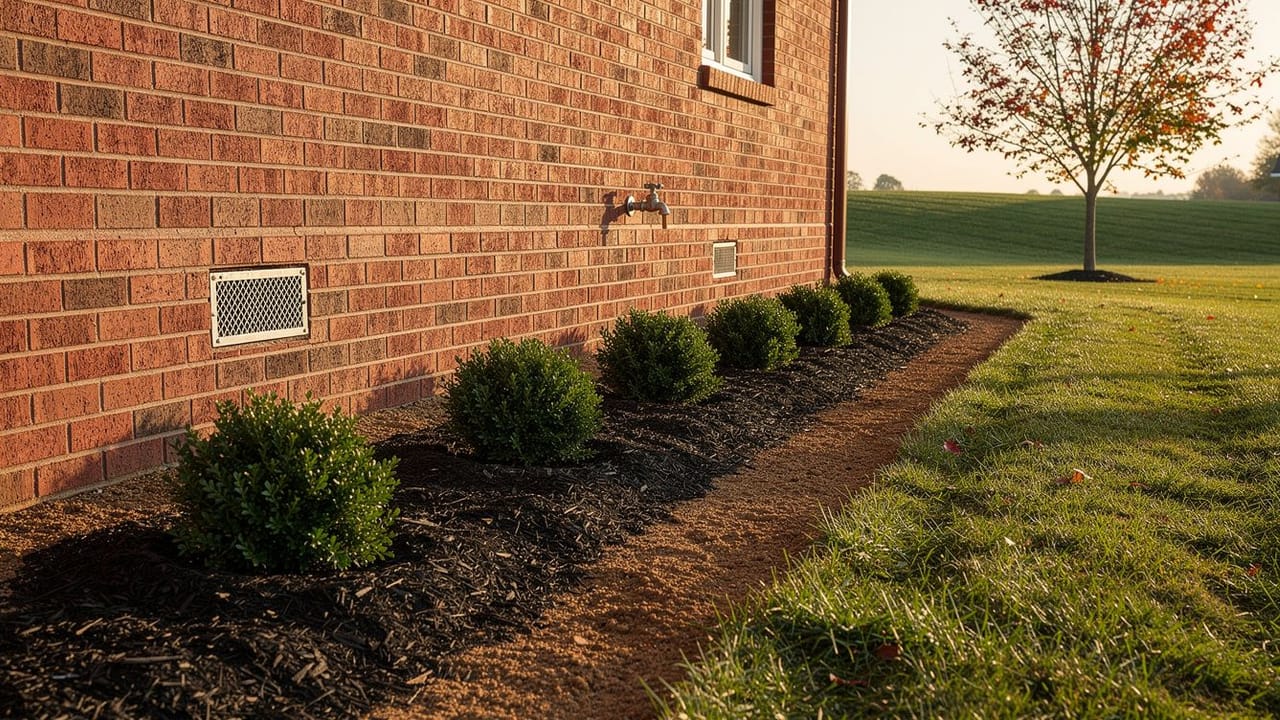
Mulch stays off the wall. Clemson Extension’s mulch fact sheet says to keep it 6 to 12 inches from the walls of buildings, and we hold it back the full foot. The reason is termites: soil treatments go down around the building, and mulch against the wall lets subterranean termites cross the treated soil. Kentucky adds that termites are drawn to mulch mainly because it holds moisture, that it should go down sparingly, and that crushed stone and pea gravel hold moisture in the soil much as wood mulch does. So the strip right at the wall stays bare, even if it looks unfinished for a season.
- Ground slopes away from the house after planting, not toward it
- Wood siding and trim sit at least six inches above the bed
- Mulch stays a full foot back from the foundation, and the strip at the wall stays bare
- Spray heads and drip lines do not wet the foundation
What should I plant in a narrow bed by the house?
The honest answer for a narrow bed, three feet or less, is a narrow plant. The Missouri pruning guide says dwarf plants in limited spaces reduce pruning needs, and even among junipers and yews, which it calls the most commonly planted narrow-leaved evergreens, some dwarf forms are available. The alternative, a full-size variety sheared into a box every year, is hard to walk back: the same guide says that once a plant has been sheared it is almost impossible to restore its natural form.
What grows well in Nashville clay is its own subject. For the strip right against the house, we check mature height as closely as mature width, so nothing grows up over a window. Get the size right for the space and the plantings will still look intentional years from now. If you are not sure a bed is wide enough for what you have in mind, ask us to look at it before anything goes in the ground.
Sources
- Clemson Cooperative Extension, HGIC 1604 Mulch (2016) — Keep mulch 6 to 12 inches from building walls so termites cannot use it to bridge treated soil
- University of Kentucky Entomology, ENTFACT-605 Protecting Your Home Against Termites — Avoid dense plantings touching the house; moist soil by the foundation attracts termites; grade away; aim irrigation away; wood siding six inches above ground; mulch sparingly; gravel holds moisture like mulch
- Virginia Cooperative Extension, 430-210 How NOT to Kill a Tree — Planting close to a house reduces root and crown space; space trees by mature size; topping causes weakening watersprouts
- University of Missouri Extension, G6870 Pruning Ornamental Shrubs — Dwarf plants in limited spaces reduce pruning; sheared plants rarely regain natural form; junipers seldom regrow from bare stubs
FAQ
How Far From the House to Plant Shrubs and Trees — questions
How close to the house can I plant a shrub?
Take the mature width on the tag and halve it, then add at least three feet of clear space between the grown shrub and the wall, more if it will grow tall. A low shrub that grows six feet wide ends up centered about six feet from the wall. That looks sparse the first year and fills in as it grows.
Do tree roots really damage foundations?
The extension guides we work from do not settle that question, so we do not promise either way. What they agree on is spacing: know how tall and wide the tree will get and plant it far enough from the house that its roots and crown have room. A large tree already close to a foundation is worth having an arborist look at in person.
Should mulch touch the house?
No. Clemson Extension recommends keeping mulch 6 to 12 inches from the walls of a building, and we hold it back the full foot, with the strip at the wall left bare. Mulch against the wall gives subterranean termites a way across the treated soil around the house, and the University of Kentucky notes that termites are drawn to mulch for the moisture it holds.
How far should trees be from the house?
Far enough to match how tall and wide the tree will grow, which is worth knowing before it goes in. A small ornamental such as a dogwood or redbud can sit much closer than an oak, maple or tulip poplar, which needs its whole mature canopy clear of the roof. On a small lot, a smaller tree often fits better.