
· by Michael Blair, Nashville's Landscapers
Landscape lighting is one of the few improvements that changes a house every single evening, and one of the most reliably disappointing when it is done cheaply. The LEDs themselves are seldom what lets it down: the Department of Energy’s LED Basics page puts the useful life of good-quality white LED products at 30,000 to 50,000 hours or longer. So when we put in outdoor lighting for a Nashville yard, most of the care goes into the wiring, the connections and where the transformer sits.
Where do low-voltage lighting systems fail?
The connections. A low-voltage system is a cable run through wet ground with a splice at every fixture, and each of those splices is a place where water can reach bare copper. When lights start dropping off a run one at a time, the splices are the first thing we dig up and look at.
We use a gel-filled or heat-shrink waterproof connector at every joint, or a silicone-filled direct burial connector. The electronics get the same thought. DOE points out that an LED lives so long there is ample opportunity for the electronics to fail before the LEDs go bad, so we mount the transformer where it stays dry. If it needs a new outdoor outlet, that is household-voltage wiring, and we leave it to a licensed electrician: Nashville has adopted the 2023 National Electrical Code with local amendments, and Metro Codes’ trades permit page says only licensed contractors with an e-permit account can apply for a trade permit online.
Voltage drop over a long run
On a long twelve-volt run, the fixtures at the far end are the ones we watch. If they look dimmer than the ones near the transformer, the cable is losing voltage on the way, and a big Nashville lot with beds along both sides of a driveway is exactly where that shows up.
Our fixes are heavier cable, splitting the load across several runs from the transformer in place of one long daisy chain, or moving the run to a higher voltage tap when the transformer has them. A fixture whose light looks a different color from its neighbors may be something else, though. DOE notes that all light sources change color over time, and an LED can last long enough for that shift to become noticeable before it fails, so the odd one out in an older system may simply be worn.
Laying it out so it does not look like an airport
The common mistake is a line of identical fixtures evenly spaced along a path or a foundation. To us it reads as runway lighting, and it flattens the house. We light from a few directions and leave dark between.
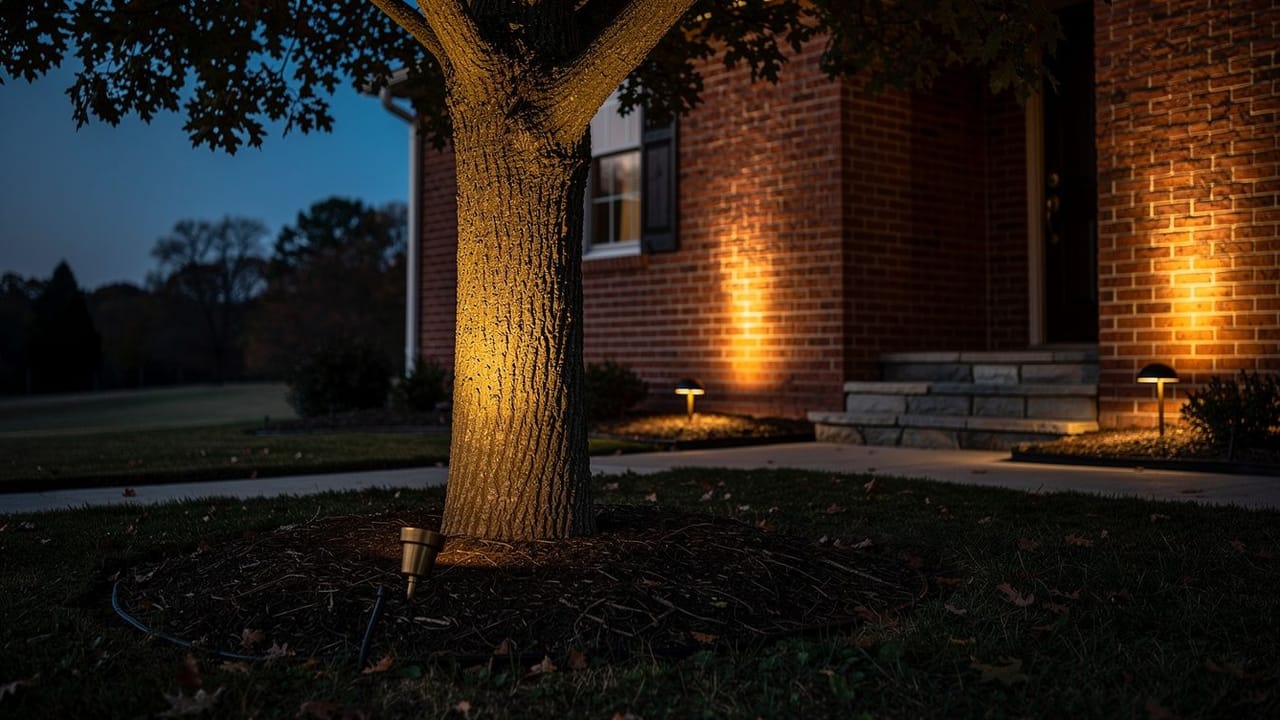
Trees with real structure get uplights, and so do the corners of the house. To bring out the texture of a brick or stone wall, we set the fixture close to the base and aim it up the face. Path lights go where the footing changes, at steps and turns, and a straight, level walk can stay unlit.
- Uplight mature trees and architectural corners
- Graze stone and brick from close range to show texture
- Path lights only where footing genuinely changes
- Leave dark gaps between lit areas
- Aim fixtures away from windows and the street
How does Middle Tennessee weather affect lighting fixtures?
Winters here are short but full of freezing nights. The National Weather Service’s Nashville climate page counts an average of 67 days a year with a low at or below 32°F, between a mean first freeze on November 11 and a mean last freeze on March 31, on top of about 50.5 inches of normal annual precipitation. On a service visit we check that every stake is still firm and every housing still sealed, and for new fixtures we lean toward solid brass or copper bodies over painted or plastic ones.
Mulch is the other quiet problem. Every top-up raises the bed a little, and a fixture set at the original grade slowly sinks until it is lighting the inside of the mulch layer. Lifting and resetting fixtures is a short job, and we do it whenever we top up a bed; our post on mulch and rock covers how deep a bed should be in the first place. If a system at your house in Nashville or nearby has gone dark in patches, ask us for a free estimate.
Sources
- U.S. Department of Energy, Solid-State Lighting: LED Basics — Useful life of 30,000 to 50,000 hours or longer, measured to 70 percent of initial output; electronics can fail before the LEDs; all light sources change color over time
- National Weather Service Nashville, Nashville climate — Average 67 days a year with a minimum at or below 32°F; mean first freeze November 11, mean last freeze March 31; normal annual precipitation 50.51 inches
- Metro Nashville Codes and Building Safety, Adopted Codes List — 2023 National Electrical Code adopted with local amendments (BL2025-898)
- Metro Nashville Codes and Building Safety, Trades Permits — Only licensed contractors with an e-permit account can apply for a trade permit online; electrical trade permit application
FAQ
Landscape Lighting That Survives a Nashville Yard — questions
How long should landscape lighting last?
The Department of Energy expects good-quality white LED products to last 30,000 to 50,000 hours or longer, counted until the light falls to 70 percent of its original output. At six hours a night, 30,000 hours is more than thirteen years. DOE also notes that the electronics have plenty of time to fail before the LEDs do, and outdoors the buried splices are the other weak point, so waterproof connectors and a transformer mounted where it stays dry are what we rely on for a long-lived system.
Can landscape lighting be added to an existing yard without digging it up?
Mostly, yes. We bury low-voltage cable to the depth the electrical code calls for, slitting it into turf or running it under the mulch in beds, so an established landscape survives the installation. Nashville has adopted the 2023 National Electrical Code. Line-voltage lighting is a different job that we leave to a licensed electrician, and Metro Codes handles electrical trade permits.
Should landscape lighting be on a timer or a photocell?
Both, ideally. A photocell follows sunset as it shifts across the year without anyone touching it, and a timer turns the system off at a sensible hour so it does not run until dawn. Where the transformer allows it we set up both, or use an astronomic timer, which works out sunset from the date and location instead of reading the light.
Why is my landscape lighting not working?
Usually a connection. Every buried splice is a spot where water can reach bare copper, so when lights drop off a run one at a time, those splices are what we dig up first. A transformer that has gotten wet is the other suspect, and far fixtures that only look dim point to voltage lost along a long run.