
· by Michael Blair, Nashville's Landscapers
Rock is usually chosen because it looks permanent and mulch looks like a recurring bill. Both impressions are fair as far as they go: Clemson Extension’s fact sheet on mulch says gravel and pebbles rarely need replenishing, while bark mulches last around 2 to 4 years. What that comparison leaves out is what each one does to the soil and the plants in it, which is the part we weigh first when we lay out new planting beds.
Does mulch or rock keep soil cooler?
Organic mulch insulates. Clemson’s fact sheet says it keeps soil cooler in summer and warmer in winter, slows the water lost to evaporation, and even notes that mulched plants put out more roots than bare ones. For a shrub planted in the ground we describe in our post on plants that thrive in Nashville clay, an even soil temperature through July is worth having.
Rock works the other way. The same fact sheet says stone and gravel reflect solar radiation and can create a very hot landscape environment during the summer months. It adds a second caution: rock can add alkaline elements and minerals to the soil, so Clemson says not to use it around acid-loving plants.
The weed argument does not hold
Rock earns its reputation on weeds, and mulch keeps pace with it. Clemson rates an inch of small rock as good weed control and gives pine bark and wood chips the same rating at 2 to 3 inches, provided the mulch itself is weed-free and deep enough to keep seeds from sprouting. The stone wins on depth, an inch against two or three, and that is about all it wins on.
If the stone goes down over landscape fabric, the fabric has limits of its own. Clemson says woven fabric controls most weeds, but some grasses grow up through the holes, and it has to be fastened down or perennial weeds push it up from below.
Where does rock make more sense than mulch?
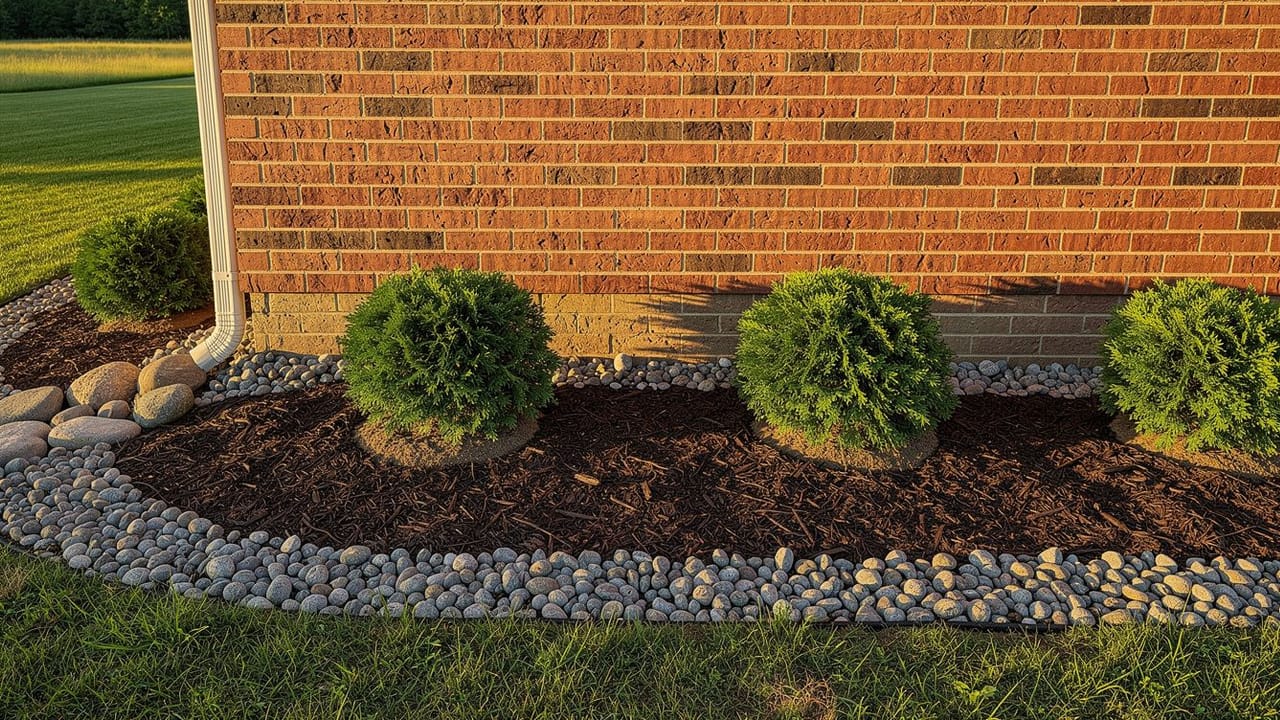
Drainage features are where we reach for stone: a dry creek bed, a downspout splash zone, a French drain outfall or the bottom of a swale. Those spots carry water on purpose, and Clemson warns that large pine bark nuggets float and may not stay in place during a heavy rain. How we route that water in the first place is the subject of our post on where the water goes in a Nashville yard.
The strip right against the house is the other place. Clemson recommends keeping mulch 6 to 12 inches from the walls of a building, because termite treatments go into the soil around the foundation and mulch against the wall gives termites a bridge across the treated ground. Stone or bare soil can fill that gap, and our post on how far from the house to plant covers the spacing for the shrubs behind it.
- Dry creek beds and swales
- Downspout and drain outfalls
- The strip along the foundation wall
- Paths and utility areas
- Succulent or gravel-garden plantings
Choosing mulch that lasts here
Shredded hardwood is our usual pick for beds. Clemson says it does not wash away easily and decomposes relatively slowly, which is the combination you want on a sloped Nashville lot. For a steep bank, the same sheet says pine needles interlock and stay in place better than most mulches on a slope.
Two to three inches is the number. Clemson says fine wood and bark mulches should go no deeper than that, because too much can suffocate roots and show up as yellowing leaves and poor growth; coarse nuggets can go to 4 inches. University of Missouri Extension’s mulch questions and answers explains what is wrong with the volcano piled around so many trees: mulch applied right up to a trunk or stem encourages decay fungi. We pull it back from every stem and top beds up in early spring, which Clemson names as the best time to mulch around established plants.
Rubber is the one we leave out of planting beds. Clemson notes that ground-tire mulch does not decompose and that its effectiveness as a mulch is still being evaluated. It has a settled job elsewhere: the Consumer Product Safety Commission’s Public Playground Safety Handbook lists shredded rubber as appropriate surfacing under play equipment. If you are weighing stone against mulch for a particular bed, ask us to come look at it before you order a load of either.
Sources
- Clemson Cooperative Extension, HGIC 1604 Mulch — Soil temperature and moisture; stone reflects solar radiation and gets very hot; rock adds alkaline elements; weed control at 1 inch of rock and 2 to 3 inches of bark; landscape fabric limits; nuggets float; mulch 6 to 12 inches from walls and termite bridge; shredded hardwood does not wash away; pine needles on slopes; depth limits; 2 to 4 year life; early spring timing; decaying mulch adds nutrients; rubber mulch still being evaluated
- University of Missouri Extension, G6958 Grass Clippings, Compost and Mulch: Questions and Answers — Mulch 2 to 4 inches deep; mulch against the trunk or stem encourages decay fungi
- U.S. Consumer Product Safety Commission, Public Playground Safety Handbook — Shredded/recycled rubber mulch listed as appropriate surfacing under playground equipment
FAQ
Mulch or Rock for Nashville Landscape Beds — questions
Does landscape fabric under mulch work?
It helps, within limits. Clemson Extension says woven landscape fabric lets water and air through and controls most weeds, though some grasses grow up through the holes and it has to be fastened down so perennial weeds do not lift it. The same fact sheet says moisture, temperature and weed control all improve with several inches of mulch on top, so fabric and mulch can work together in a planting bed.
How often does mulch need replacing in Nashville?
Less often than most people expect. Clemson Extension, writing for South Carolina conditions, puts pine needle and bark mulches at around 2 to 4 years before more is needed, while wood chips are usually gone within 2 years and leaves and grass clippings much sooner. Early spring is the best time to add it around established plants. The breakdown is part of the point: as organic mulch decays into the soil it improves the topsoil and adds nutrients, which gravel, since it does not decompose, never does.
Is rubber mulch a good alternative?
Not for planting beds, in our view. Clemson Extension notes that ground rubber mulch does not decompose, so it never adds organic matter to the soil the way bark does, and that its effectiveness as a mulch is still being evaluated. Its established use is under play equipment: the Consumer Product Safety Commission’s playground handbook lists shredded rubber among the appropriate surfacing materials.
Is rock or mulch better for landscaping?
For planting beds, mulch in most cases: it evens out soil temperature, holds moisture and feeds the soil as it breaks down, while rock gets hot in summer and can raise alkalinity. Rock is the better choice where water runs on purpose, such as dry creek beds and downspout outfalls, and in the strip beside the foundation.