
· by Michael Blair, Nashville's Landscapers
A wet patch that comes back after every storm is easy to stop seeing. It deserves a second look, because where the water sits, and how close it is to the house, decides whether you have a lawn nuisance or a grading and drainage job.
Three different problems that look the same
When water runs in from uphill, we look at catching it before it reaches the low spot, usually with a shallow swale or a drain laid across the slope. When it sits where it fell, the ground underneath is taking it in too slowly, and that is a question for a soil test rather than a guess. Even a puddle out in the open lawn is worth fixing: EPA’s guide to mosquito control lists draining temporary pools of water, or filling them with dirt, under removing the places mosquitoes breed around a home.
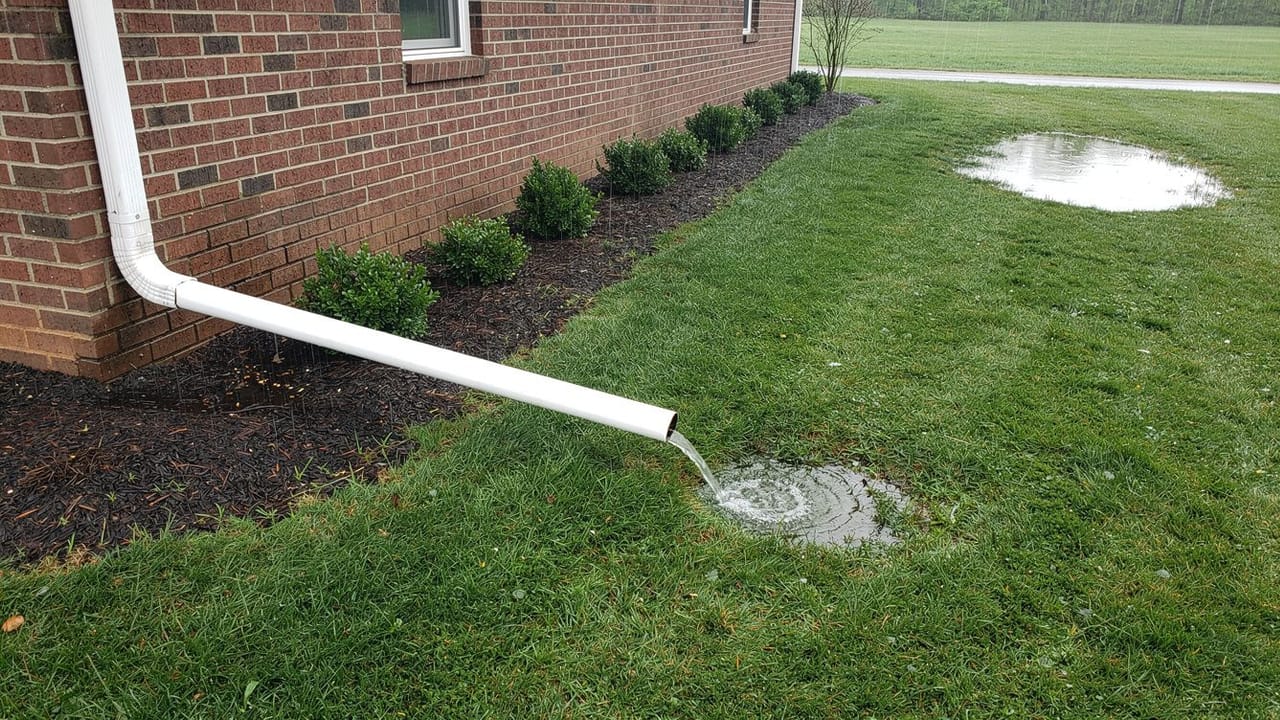
When water shows up along the house after a rain, the first place we look is the roof. A downspout that empties a few feet from the wall puts everything that stretch of gutter collects right against the foundation.
What is the cheapest fix for yard drainage?
Extend the downspouts. Metro Water Services’ stormwater maintenance page tells property owners to point them away from hard surfaces and toward ground where the water can soak in, and EPA’s Soak Up the Rain page on redirecting downspouts cautions that redirecting one is not right for every location, so watch where the water goes next. Temporary extensions let you see a few storms play out before anything gets buried.
Then look at the ground along the foundation. It should fall away from the house on every side. When we find it running back toward the wall, a settled bed or years of added mulch is the first thing we check, which is why our guide to spacing beds and shrubs off the house keeps bed soil below the siding.
When a French drain is the right answer
A French drain is a gravel trench around a perforated pipe that collects water below the surface and carries it somewhere else. We only build one where there is a lower place for it to empty, because without that the pipe fills and sits there holding water.
On a flat lot we talk through the other routes instead: regrading to make some fall, a pump, or a dry well where the soil will take water. Anything meant to soak water into the ground belongs well clear of the house, and Metro’s standard for infiltration trenches places them at least 25 feet from building foundations and says a licensed engineer should be consulted on the setbacks. Where the water ends up matters next door too, since Metro Water Services lists runoff from one private property onto another among the problems it leaves to property owners.
- A lower outlet confirmed before we price it
- Clean angular stone around the pipe
- Filter fabric between the stone and the native soil
- A cleanout so the line can be flushed later
- An outlet that empties on your own ground, not a neighbor’s
Does clay soil limit rain gardens and dry wells?
Anything that relies on the ground soaking water up, a rain garden or a dry well, works only as well as the soil under it. Metro’s infiltration trench standard rules a trench out where the tested soil takes in 0.5 inch an hour or less, and it flags a high risk of clogging where clay or silt soils drain toward one. For the planted bioretention basins in the same set of rules, Metro’s low impact development manual asks installers to check that stormwater soaks into the soil within 24 hours after a storm. Clay shapes what will grow in a wet spot as well, which our post on plants for Nashville clay covers.
Test the soil rather than assume. Digging a hole, filling it and checking it the next morning is only a rough first look, but if it is still holding water, we plan around the soil instead of relying on it. Metro’s formal test is stricter: the soil is presoaked for 24 hours, then the drop in water level is measured over an hour, four times, and reported in inches per hour. If you want us to look at where the water goes on your lot, request a free estimate and tell us where it pools.
Sources
- Metro Water Services, Stormwater Maintenance — Direct downspouts away from impervious surfaces toward ground that can soak water in; runoff from one private property to another is the property owner’s responsibility, not Metro’s
- US EPA Soak Up the Rain, Disconnect and Redirect Downspouts — Downspout disconnection may not be appropriate for all locations; consider where the water will be directed
- Metro Water Services, Stormwater Management Manual Vol. 5, GIP-04 Infiltration Trenches (2021) — At least 25 feet from foundations, engineer to set setbacks; not used at 0.5 in/hr or less; clogging risk with clay or silt in the drainage area; 24-hour presoak and four one-hour readings
- Metro Water Services, Stormwater Management Manual Vol. 5, Low Impact Development Manual (2021) — Urban bioretention: check that stormwater infiltrates within 24 hours after a storm
- US EPA, Success in Mosquito Control: An Integrated Approach — Drain temporary pools of water or fill with dirt to remove mosquito habitat around homes
FAQ
Where the Water Goes in a Nashville Yard — questions
How far should downspouts discharge from the house?
Metro Water Services does not give a distance. Its advice is to point downspouts away from hard surfaces and toward ground where the water can soak in, and EPA cautions that redirecting a downspout is not right for every location. The real test is where the water goes next: it should keep moving away from the house and not end up against your wall or a neighbor’s. We try temporary extensions through a few storms before burying a line.
Will a French drain fix standing water in a flat yard?
Usually not on its own. The pipe needs a lower point to empty into, and in a yard with no downhill it fills and stays full. On a flat lot the options we talk through are regrading to create some fall, a pump, or a dry well where a soil test shows the ground will take the water, kept well away from the foundation.
Is standing water actually damaging?
Near the house, we treat it as the first thing to fix, since that water is closest to the foundation and the crawl space. Out in the open yard, the clearest risk is mosquitoes, and EPA’s mosquito control guidance says to drain temporary pools of water or fill them with dirt. How close it sits to the house decides how urgent it is.
How do I fix drainage in my yard?
Begin by tracing where the water comes from. Extend the downspouts and watch a few storms, make sure the ground slopes away from the house, and catch uphill runoff with a swale. A French drain works only where there is a lower outlet, and soak-in options such as a dry well depend on a soil test first.