
· by Michael Blair, Nashville's Landscapers
Most foundation beds in Middle Tennessee have at least one plant in the wrong place: a holly that now blocks a window, a hydrangea spilling onto the walk, a camellia that went in six feet too close to its neighbor. The usual answer is a chainsaw. Often the better one is a spade, because a healthy shrub that has been in the ground a few years is worth moving, and Clemson Extension’s fact sheet on transplanting established trees and shrubs names October and November as the fall months to do it. The work is not complicated, but the details decide whether the plant lives. If the plant went in too close to the house to begin with, our post on how far from the house to plant covers where its new spot should be.
Why fall works better than spring
A moved shrub leaves most of its roots behind in the old hole. Clemson’s answer is to plan the move months ahead: plants to be moved in October or November get their roots pruned the March before, and the fact sheet warns that a plant moved without root pruning may die from transplant shock because of the root loss. Pruning early keeps most of the roots within a small area, so more of them travel with the ball.
Spring is the other window the fact sheet gives: a March move, with the roots pruned the October before. We still prefer fall. A shrub moved in October has the whole cool season in its new spot before its first Tennessee summer there, about five months more than a March move gets. If nobody pruned the roots last March, we make up for it as far as we can with a wider ball and a careful dig.
Which shrubs are worth moving?
The first question we ask is whether the plant is healthy and still the right plant, only in the wrong place. Clemson does not rate shrubs one by one; the plants it calls difficult to move are trees, beech, hickory, sweet gum and white oak among them. What it does set by type is how the plant travels. Shrubs under 3 feet tall can be moved bareroot and planted while dormant, but every broadleaf and narrowleaf evergreen, holly, boxwood and camellia included, should be moved with its soil attached.
Size decides more of these jobs than species does. By Clemson’s figure, a ball of soil 15 inches across and 15 inches deep may weigh 200 pounds or more, and the fact sheet suggests hiring a professional arborist or landscape manager for balls weighing several hundred pounds. That is work our planting crews take on, and past a certain size the cost is worth weighing against buying a new plant for the spot. If you would rather we look at the shrub before you pick up a spade, ask us for an estimate.
Digging it out with enough roots
Tie the branches up with twine first, which is Clemson’s first step for both root pruning and digging, and mark a branch that faces north so the plant goes back in facing the way it grew. Then cut a circle straight down with a sharp spade, outside any root-pruning trench and far enough out to keep enough of the fibrous and feeding roots for the plant to recover fully. The fact sheet’s table for deciduous shrubs gives the minimum: a ball 14 inches across and 11 deep for a 3-foot shrub, 18 by 14 for a 5-foot one, 22 by 15 at 7 feet. A wider ball is heavier, and it is also what keeps the plant alive.
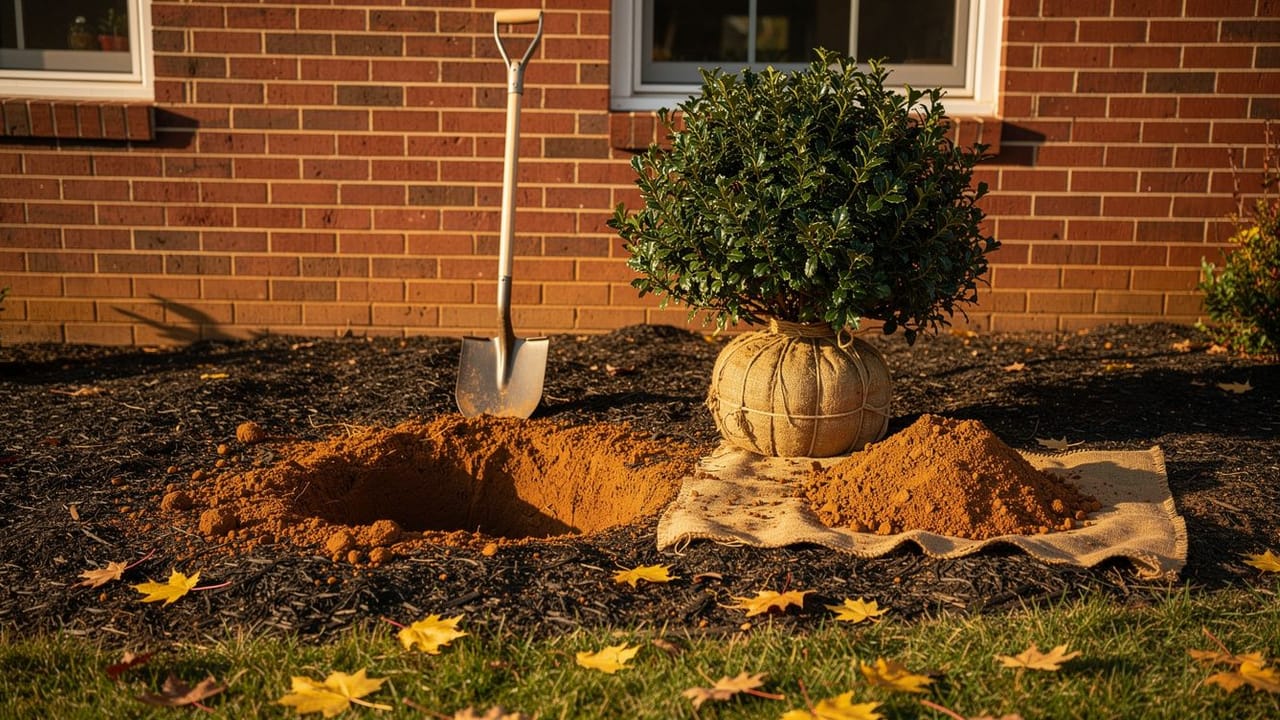
Wrap the ball tightly in burlap so the soil does not dry, crack or crumble, and lift a small one the way Clemson describes, with burlap slid under the ball and lifted by its four corners. We dig the new hole before the old plant comes out, so it goes straight from one to the other. Make it one and a half to two times as wide as the ball: Clemson says 50 percent wider for a balled plant, and Virginia Tech Extension’s list of common tree care mistakes says at least twice as wide as the root system for a tree. Neither wants it deeper than the roots sat before. Clemson warns that roots planted too deep suffocate for lack of oxygen and keeps the root collar no more than an inch below the soil surface, so in our clay we set the top of the ball level with the grade or a touch above it.
Backfill with the soil that came out of the hole. Virginia Tech is direct on this point: do not amend the backfill for individual holes, and amend only when the whole planting area can be amended evenly.
- Root prune the March before a fall move, when there is time to plan
- Tie up the branches and mark the side that faces north
- Dig the new hole first, wider than the ball and no deeper
- Set the ball at the depth it grew, never buried
- Backfill with the native soil and water it in
How do you care for a moved shrub through winter?
Water it in as soon as the hole is filled. Clemson’s reasons are to settle the disturbed soil, remove air pockets and give new roots moisture, and from then on the aim is constant moisture in the root ball without saturating it. Clay is the poorly drained soil in that fact sheet, so we check the soil at the edge of the ball before watering instead of watering on a schedule. Two to three inches of mulch over the root zone, pulled back off the stems, is the depth both Clemson and Virginia Tech give.
Leave the fertilizer in the shed. Clemson’s fact sheet on fertilizing trees and shrubs says that when planting shrubs and trees, water, and not fertilizer, is the most important element for getting them established. We come back to look at the plant once it leafs out in spring. And before anyone digs near the foundation or a walk, Tennessee 811 says state law requires anyone excavating, hand digging included, to give it at least three full business days of notice so the buried lines are marked first.
Sources
- Clemson Cooperative Extension HGIC, Transplanting Established Trees and Shrubs (HGIC 1055) — October or November fall moves and March spring moves; root pruning months ahead and transplant shock without it; bareroot under 3 feet, evergreens with soil; difficult trees; tie up branches, mark north; ball-size table for deciduous shrubs; ball weight and hiring a professional; burlap; hole 50 percent wider, same depth, root collar, suffocation; water to settle soil, constant moisture; 2 to 3 inches of mulch
- Virginia Tech Cooperative Extension, How NOT to Kill a Tree: 24 Common Tree Care Mistakes (430-210) — Hole at least twice as wide as the root system and only as deep; do not amend backfill for individual holes; mulch 2 to 3 inches, off the trunk
- Clemson Cooperative Extension HGIC, Fertilizing Trees & Shrubs (HGIC 1000) — Water, not fertilizer, is the most important element for establishing new plantings
- Tennessee 811 — Tennessee law requires at least three full business days of notice before any excavation, including hand digging
FAQ
Moving an Established Shrub Before Winter — questions
What is the best month to transplant shrubs in Middle Tennessee?
October and November are the fall months Clemson Extension gives for moving an established shrub, and fall is when we prefer to do it. March, before the buds break, is the spring alternative it names. Either way the plant does better if its roots were pruned months ahead: in March for a fall move, in October for a spring one.
How big a root ball does a shrub need when it is moved?
Clemson Extension sizes the ball by the height of the plant. For deciduous shrubs its table calls for at least 14 inches across and 11 inches deep on a 3-foot shrub, 18 by 14 on a 5-foot shrub and 22 by 15 on a 7-foot one, so the ball holds enough of the fibrous feeding roots for the plant to recover. Expect real weight: Clemson puts a 15-by-15-inch ball at 200 pounds or more.
Should I prune a shrub when I move it?
Clemson’s transplanting fact sheet prunes the roots months ahead and does not call for cutting back the top; for the dig it has you tie the branches up out of the way. We take out dead or broken wood while the plant is tied up and leave any shaping until its normal pruning time, once it has settled in the new spot.
What causes transplant shock in shrubs?
Mostly root loss. A shrub that is dug up leaves most of its roots in the old hole, and Clemson warns that one moved without root pruning may die of transplant shock. Pruning roots months ahead, keeping a wide ball, planting no deeper than before and holding the ball evenly moist all cut that risk.