
· by Michael Blair, Nashville's Landscapers
Spring is when most people get the urge to plant, and a spring tree can do fine, but it is not the month we would pick for a tree or shrub in Middle Tennessee. UT Extension’s guide to transplanting trees says container and balled-and-burlapped trees can go in any time the ground is not frozen. The trouble with April is what follows it. By the National Weather Service’s Nashville climate normals, the city averages 49 days a year at 90°F or hotter, and 47 of them fall between June and September.
Why is fall the best time to plant trees?
The first summer is the hard one because a moved tree has lost most of its roots. UT notes that a balled-and-burlapped tree usually leaves about 95 percent of its original root system behind in the nursery field, and it names water stress as the primary cause of transplant failure. Until new roots grow out into the soil around the ball, the tree is drinking through a small fraction of what it had, which is why we want that growth done before the heat.
A tree planted in October has the rest of fall, the winter and all of spring before its first hot spell. The same tree planted in late April gets May, which averages two days at 90°F, and then June, which averages ten. Nashville’s average first freeze is November 11 and its average last is March 31, by the same NWS page, and UT’s only condition for a container or balled tree in between is that the ground itself is not frozen.
What each type wants
Trees and shrubs: UT allows any time the ground is not frozen for container and balled-and-burlapped stock, and the dormant season, December through March, for bare-root trees. Within that, our planting work is scheduled for October through early December where we can, with late winter as the second choice, and we do not dig into ground that is frozen or standing in water.
Perennials are less particular. We plant them in spring or early fall and lean toward fall for anything that sulks in summer heat. Bermudagrass and zoysia go the other way: UT’s lawn care guide to the fescues describes them as warm-season grasses that grow best between 80 and 95°F, so we put them down once the weather has turned warm.
Fescue is the reverse. UT says to seed it from August 20 to September 15, warns that seed sown too late in the fall gives immature plants prone to winter stress, and notes that young spring-sown fescue often fails to survive its first summer. It prefers September, October and March for fescue sod, which is the calendar our grading and sod crews work to. For spring-flowering bulbs, UT’s Flowering Bulbs for Tennessee Gardens gives late September through early November, before the ground freezes.
- Container and balled-and-burlapped trees and shrubs: any time the ground is not frozen, and we prefer October to early December
- Bare-root trees: December to March
- Perennials: early fall or spring
- Bermudagrass and zoysia: once the weather turns warm
- Fescue seed: August 20 to September 15
- Spring bulbs: late September to early November
The watering obligation nobody mentions
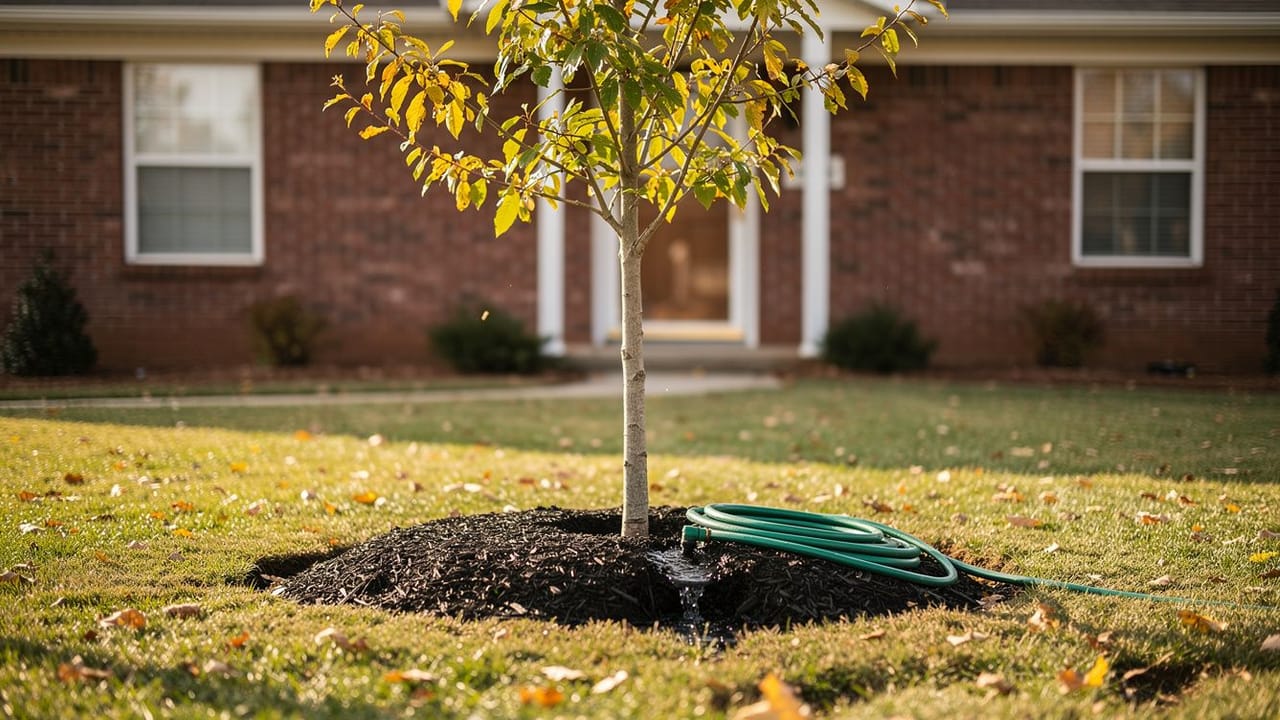
Fall planting does not get you out of watering. October is Nashville’s driest month on average, with a normal of 3.36 inches against 50.51 for the year in the NWS figures, so the season we like best for planting is also the one most likely to need a hose. UT’s instructions are to irrigate slowly so the water soaks into the ground, to avoid overwatering, and to expect that watering through dry periods may be needed for several years until the tree is fully established.
UT lists planting too deep and over- or under-watering as the most common transplanting mistakes, and neither has anything to do with the calendar. A shrub moved from one bed to another is a transplant too, and our post on moving an established shrub in fall covers the digging side of it.
Can you plant trees in summer in Middle Tennessee?
Nothing is strictly off-limits, and UT does not rule summer out for container or balled-and-burlapped trees. We still hold woody plants back in July and August when a homeowner can wait. Those two months average 31 days at 90°F or hotter between them, and each one is a day a reduced root ball has to keep a full canopy supplied.
If something has to go in during summer, we plant it the way UT describes and then water more often: a hole at least three times as wide as the root ball and no deeper, the tree set about two inches above the surrounding ground, the hole backfilled with the soil that came out of it, a thorough soak, and 2 to 3 inches of mulch kept 6 inches off the trunk. Leave the fertilizer in the shed as well, since UT’s guide to fertilizing landscape trees says newly planted trees do not need any during their first growing season. If you would rather we did the planting, ask us for a free estimate.
Sources
- UT Agricultural Extension Service, SP 572 Transplanting Trees (2000) — Container and B&B trees any time the ground is not frozen; bare-root December to March; 95 percent of roots left in the field; water stress the primary cause of failure; most common mistakes; slow-release fertilizer only if any at planting; hole width, height and backfill; mulch depth; slow watering for several years
- National Weather Service Nashville, Nashville climate (BNA normals) — Average days at or above 90°F by month (49 a year); average first freeze November 11 and last March 31; monthly precipitation normals, October lowest at 3.36 inches
- UT Extension, PB1576 Lawn Care: Selecting, Establishing and Maintaining the Fescues — Bermudagrass and zoysia grow best at 80 to 95°F; fescue seeding August 20 to September 15; late-fall and spring seeding risks; fescue sod preferred in September, October and March
- UT Agricultural Extension Service, PB 1610 Flowering Bulbs for Tennessee Gardens (1998) — Spring bulbs planted late September through early November, before the ground freezes; drainage test for clay soil
- UT Agricultural Extension Service, SP 548 Fertilizing Landscape Trees (1999) — No fertilizer needed the first growing season; excess damages the tree; no nitrogen on trees August 1 to November 15 in Tennessee; keep fertilizer 12 inches from the stem
FAQ
The Right Month to Plant in Middle Tennessee — questions
Is it too late to plant a tree in December in Nashville?
Usually not. UT Extension says container and balled-and-burlapped trees can be planted any time the ground is not frozen, and it puts bare-root trees in the dormant season, December through March. What matters more than the date is a hole that drains. UT’s bulb guide gives a simple test: dig a hole about a foot deep, fill it with water, and fill it again the next day. If the second filling has not drained in eight to 10 hours, the soil most likely has a high clay content.
How much should I water a new tree?
UT Extension gives no gallon figure for a new tree. Its advice is to water slowly so it soaks into the ground, to avoid overwatering, and to keep watering through dry spells, possibly for several years, until the tree is established. Before watering again we push a trowel a few inches into the soil beside the root ball to see whether it is still damp, and we let a hose trickle at the base so the water goes in where the roots are.
Should I fertilize at planting?
Generally no. UT Extension says newly planted trees do not need fertilizer during the first growing season, and that excessive fertilizing in the first year can damage the tree and slow its growth. It also says nitrogen should not go on trees in Tennessee between August 1 and November 15, which covers most of the fall planting season. If fertilizer is used at planting, UT calls for a slow-release product and none within 12 inches of the stem, because fertilizer can burn young stem tissue.
Can you plant trees in spring?
Yes, a spring tree can do fine, and UT Extension allows container and balled-and-burlapped trees any time the ground is not frozen. The catch is the summer that follows: a late-April tree gets May before June brings an average of ten days at 90°F or hotter, so it needs closer watering through that first summer.