
· by Michael Blair, Nashville's Landscapers
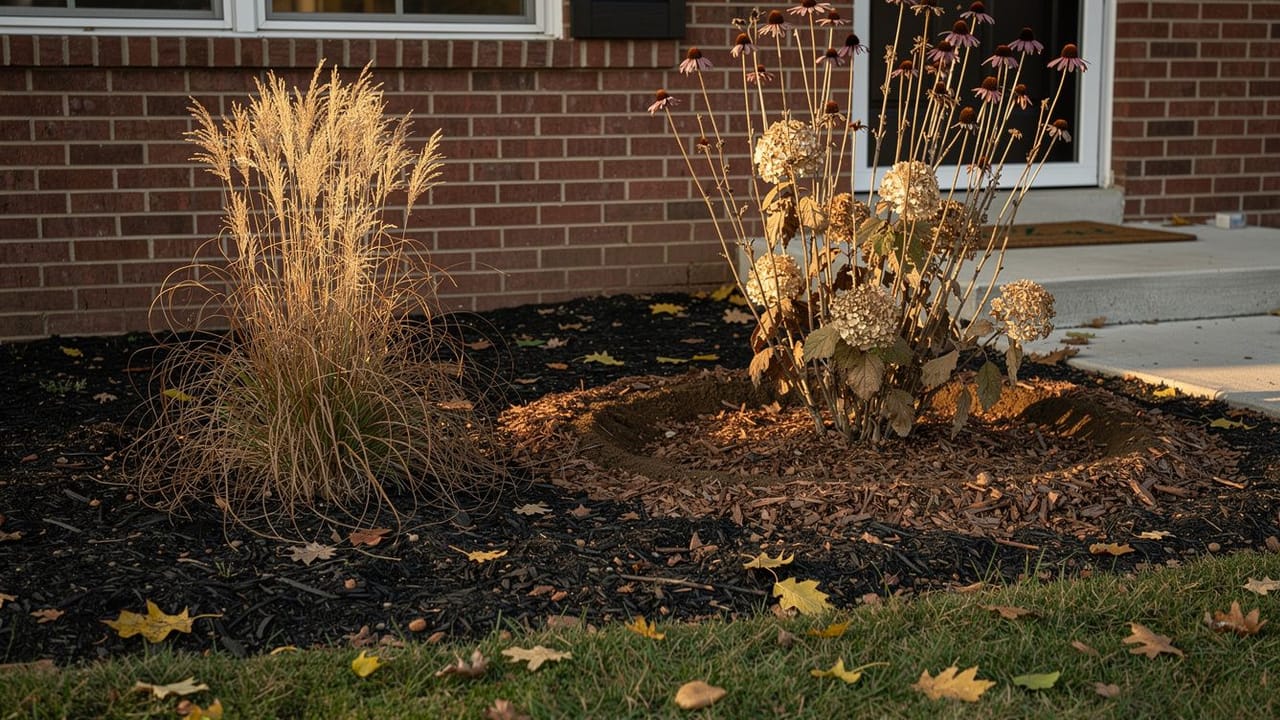
Fall cleanup in Nashville tends to mean one thing: cut it all down, bag it, mulch it, done. A landscape treated that way looks neat in November and pays for it later, when the bigleaf hydrangeas do not bloom, the butterfly bush cut back in October has taken cold damage, and beds left bare all winter have lost soil to the rain. When we do a fall pass on a client’s planting beds, we sort the yard into what benefits from cutting now, what needs to wait, and what should stand until the end of winter.
What should be cut back in the fall?
Anything diseased goes first, whatever the usual timing for that plant. Foliage that spent the summer spotted or coated in powdery mildew gets cut, bagged and taken off the property instead of going on the compost pile; we would rather not leave it lying in the bed until spring.
Hostas and daylilies we cut once a hard frost has flattened them, since there is nothing left standing worth keeping. Spent annuals come out. Self-seeders are a judgment call: coneflower, which NC State Extension’s purple coneflower profile says will reseed itself in the garden, is one we usually leave standing for the reasons below, and in a bed already crowded with seedlings we take off some of the seed heads and leave the rest.
Which plants should stand until late winter?
Ornamental grasses are the clearest case. Clemson Extension’s fact sheet on ornamental grasses says that because many grasses look good in the garden through winter, they are usually cut back in late winter or early spring, before the new season’s growth starts, with the stems taken to a few inches above the ground. The same sheet warns that some evergreen grass-like plants, sedges among them, are slow to recover from being cut, and suggests combing the old leaves out by hand in spring. Coneflower is the other plant we leave alone. NC State’s profile says songbirds, especially American goldfinches, eat the seeds, and that native bees nest in the dead, hollow stems, so it suggests cutting dead stems back to 12 to 24 inches and letting them stand until they break down on their own.
Woody-based plants are where a fall haircut does the most harm, and each has its own timing. Butterfly bush flowers on new growth: Clemson’s butterfly bush fact sheet recommends cutting it to within a foot of the ground before new growth begins in spring and warns that fall or winter pruning raises the risk of cold damage, and NC State’s butterfly bush profile also puts the cut in early spring. NC State’s Russian sage profile says to cut the stems to several inches above the ground in early spring; if a rangy plant has to be tidied in fall, it allows cutting to 12 inches after the first hard frost, and that is as far as we go. Lavender is the touchy one in our ground. NC State’s English lavender profile says it does not like wet feet and will die out in heavy clays, and it puts the yearly trim after the flowers fade, so in October we leave it be. Our post on plants that hold up in Nashville clay covers where it belongs in the first place.
Shrubs: know which wood it flowers on
This is where fall pruning does the most damage. NC State’s bigleaf hydrangea profile says the plant blooms in late spring and summer on the previous year’s growth and to do any pruning before August 1, and Clemson’s hydrangea fact sheet gives the same date so next year’s buds are not removed. Oakleaf hydrangea works the same way; NC State’s oakleaf hydrangea profile says that because it blooms on old wood, any pruning should happen right after it flowers. Cut either one in October and you have cut off next summer’s flowers.
Panicle hydrangea is the opposite. According to NC State’s panicle hydrangea profile, it blooms on new growth and not on the woody stems from the year before, so it can be pruned hard in late winter or spring. Crape myrtle also flowers on new growth, and Clemson’s crape myrtle pruning fact sheet puts any needed pruning in late winter or early spring. It calls topping “Crape Murder” and says that usually only light pruning is needed, if any: take out branches that cross or rub and shoots growing into the center of the canopy. If you are not sure which hydrangea you have, leave it alone this fall and watch where it blooms next year.
- Bigleaf and oakleaf hydrangea: prune right after flowering, never in fall
- Panicle hydrangea, crape myrtle and butterfly bush: late winter or early spring
- Broadleaf evergreens: we shape them lightly in spring
- Deadwood: any time it is obvious
Leaves, mulch and the beds themselves
Leaves that fall into beds can mostly stay as a winter mulch, as long as they do not mat. Clemson Extension’s mulch fact sheet recommends shredding them coarsely with a shredder or a lawn mower, because whole leaves tend to blow away and finely shredded ones keep water from soaking in, and it says shredded leaves should never go deeper than 2 inches, since they mat together and starve the roots of water and air. The same sheet lists what a mulch layer does: it slows evaporation, keeps soil cooler in summer and warmer in winter, and stops the splashing that leads to erosion. It also says to keep mulch 2 to 3 inches back from the stems of woody plants to prevent decay and winter rodent damage, which is how we lay it when we top beds up in fall. Whether a bed should be mulch at all is its own question, and our post on mulch or rock for Nashville beds works through it.
Bare beds are what we worry about most on a sloped lot. A bed scraped to bare soil in October takes every winter rain directly, with nothing to stop the splash. Leave the plant cover, keep the mulch in place, and do the heavy cutting in one pass at the end of winter. If you would rather hand that pass to a crew, tell us about the yard and we will come and look at it.
Sources
- NC State Extension Plant Toolbox, Echinacea purpurea (purple coneflower) — Reseeds itself; goldfinches eat the seeds; native bees nest in dead stems, cut them to 12 to 24 inches and leave them standing
- Clemson Cooperative Extension HGIC 1178, Ornamental Grasses and Grass-like Plants (2017) — Cut back in late winter or early spring before new growth, stems to a few inches; sedges slow to recover from cutting
- Clemson Cooperative Extension HGIC 1084, Butterfly Bush (2007) — Flowers on new growth; cut to within a foot before spring growth; fall or winter pruning raises the risk of cold damage
- NC State Extension Plant Toolbox, Buddleja davidii (butterfly bush) — Flowers on new growth; best pruned in early spring
- NC State Extension Plant Toolbox, Perovskia atriplicifolia (Russian sage) — Cut to several inches in early spring; rangy plants can be cut to 12 inches after the first hard frost
- NC State Extension Plant Toolbox, Lavandula angustifolia (English lavender) — Dislikes wet feet and dies out in heavy clay; trimmed after the flowers fade
- NC State Extension Plant Toolbox, Hydrangea macrophylla (bigleaf hydrangea) — Blooms on the previous year’s growth; prune before August 1
- Clemson Cooperative Extension HGIC 1067, Hydrangea Care in South Carolina (2025) — Bigleaf hydrangea flowers on old wood; avoid pruning after August 1
- NC State Extension Plant Toolbox, Hydrangea quercifolia (oakleaf hydrangea) — Blooms on old wood; prune right after flowering
- NC State Extension Plant Toolbox, Hydrangea paniculata (panicle hydrangea) — Blooms on new growth; can be pruned hard in late winter or spring
- Clemson Cooperative Extension HGIC 1009, Crape Myrtle Pruning (2015) — Flowers on new growth; prune in late winter or early spring; topping is “Crape Murder”; light thinning usually enough
- Clemson Cooperative Extension HGIC 1604, Mulch (2016) — Shred leaves coarsely, no deeper than 2 inches; mulch slows evaporation, evens soil temperature and stops erosion from splashing; keep it 2 to 3 inches from woody stems
FAQ
Fall Cleanup: What to Cut Back and What to Leave — questions
Should I cut back hydrangeas in the fall?
Not bigleaf or oakleaf types. Both bloom on old wood, so a fall cut removes next year’s flowers; NC State and Clemson Extension both say to finish pruning bigleaf hydrangea before August 1, and oakleaf is pruned right after it blooms. Panicle hydrangeas bloom on new growth and can be cut back in late winter or spring. When in doubt, leave it until you see where it flowers.
Is it better to cut perennials in fall or spring?
It depends on the plant. Ornamental grasses, coneflower, Russian sage and butterfly bush are all better cut in late winter or early spring, and coneflower’s standing stems and seed heads feed goldfinches and give native bees somewhere to nest over winter. In fall we cut what is diseased and what frost has already flattened, and leave the rest standing until the end of winter.
Can I leave the leaves in my landscape beds?
Yes, as long as they do not mat. Shred them coarsely, with a mower if you do not have a shredder, and keep the layer to about 2 inches so water and air still reach the roots. Keep them a few inches back from shrub stems. Leaves left thick on the lawn are a separate job; we mow them in or rake them off.
What does a fall cleanup include?
Ours covers cutting out diseased foliage and bagging it off the property, cutting hostas and daylilies once frost flattens them, pulling spent annuals, shredding leaves into the beds and topping up mulch held back from woody stems. Grasses, coneflower and woody-based perennials are left for one pass at the end of winter.